Month: April 2010

  • United Balls – “Pogo In Togo”, “Good Understanding”, “Blackbird”, “Gisela”, “Gänseblümchen”, “No More Feelings” and “Sur Le Pont D’Avignon”

    United Balls album "Pogo In Togo"

    I think it was 1978 on a trip to Germany, before I lived there, that I came across German band United Balls, whose 1981 album “Pogo In Togo” I would later acquire, with songs like “Blackbird”, Good Understanding”, “Gisela” and the title track “Pogo In Togo”.

    What I of course couldn’t know was that I would later meet them and even sit with them at the dinner table a few years later. They were really nice, down to earth guys.

    My first introduction to United Balls, who were founded in 1973, was an A5 leaflet I picked up somewhere, either in Munich or Berlin I think, in a pub, café or university dining room. Just a black and white piece of paper advertising a gig.

    A few years later, living in Bamberg in Upper Franconia in the north of Bavaria (I am being quite specific here as the Franconians, while part of Bavaria politically, don’t consider themselves Bavarians!), I got a copy of the United Balls album “Pogo In Togo” on tape.

    Can’t remember the circumstances, but I have it!

    United Balls logo

    The tracks are both German and English, sometimes mixed up in the same song, and have a kind of staccato, more or less punk/New Wave sound. (The late Seventies and early Eighties were after all the period of Neue Deutsche Welle/NDW, or German New Wave.)

    And then in either 1983 or early 1984, while working as a roadie for a local dance band, we were playing in a little place called Hollfeld, just south of the main road from Bamberg to Bayreuth.

    We had two or three gigs there sharing the stage with well-known bands from Munich, such as Relax and Münchner Freiheit, and on this occasion United Balls.

    Whereas the other acts came with all their gear and their own roadies (on one of these occasions one of our microphones disappeared), United Balls turned up on their own in a VW van, plugged their guitars into our amps and their drummer used our drum kit.

    Simple but effective, and definitely economical – and sounded just as good.

    Here’s the van (on this occasion photographed in Hamburg):

    United Balls touring van

    At first I could only find videos of two songs from that first album (two others followed), and a couple of others I didn’t know, but then I turned up a few more after all.

    The title track from “Pogo In Togo” actually reached Number 1 in New Zealand and Australia – in Germany it “only” got to No. 14, but they still sold over a million copies altogether.

    The chorus is very simple – Pogo in Togo – and one of several cover versions changed it to “Dio in Rio”.

    Here is the original of “Pogo In Togo” (keep your eye on the blonde guitarist on the left, more about him later…):

    Don’t you just love the elephants!

    And because it’s such fun jumping up and down, here they are again playing in front of a live audience in 1980 (after a pause at the beginning):

    “Good Understanding” was the second track from the first album, also in English:

    Another English track from the debut album, “Blackbird” (there’s no sound until about 20 seconds into the video):

    Short and sweet, “Gisela” is one of my favourites:

    They look like maniacs here, but singer and guitarist Horst Lindhofer went on to found biotech company Trion Pharma in 1998, which together with Fresenius Biotech was the first German biotech firm to develop and market a “recombinant antibody” to treat cancer.

    After an almost 20 year break the band is playing again, as documented in this brief German language video (the sound of the music recording is a little hairy):

    And this live video from July 2013 (Tollwood Festival in Munich, three weeks after ZZ Top played there):

    Another one that’s short and sweet but nice to jump about to, “Gänseblümchen” (“I’d like to pick daisies for my girl…”):

    “No More Feelings” sounds like a bit like Gisela, but has it’s own charm:

    I don’t remember this one, certainly another take on “Sur le pont d’Avignon”:

    Hmm, different!

    Paul
  • Don McLean – “American Pie”, “Vincent (Starry, Starry Night)”, “Crying”, “Since I Don’t Have You” and “Castles In The Air”

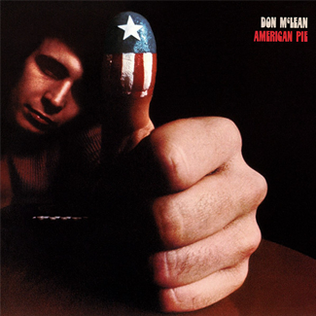
    Cover of Don McLean album "American Pie"

    I can’t remember a time without Don Mclean singing “American Pie” and Vincent”, and yet it was only 1971 when the former was released and 1972 when it topped the charts for weeks on end.

    Like the phrase it coined, “The day the music died”, it has been a part of our culture ever since.

    Ladies and gentlemen – “American Pie”, the studio version:

    And “American Pie” live in 1972:

    Much quieter and more reflective, yet equally memorable, is Don McLean’s tribute to 19th century Dutch painter Vincent van Gogh, “Vincent (Starry, Starry Night)”:

    Towards the end of the decade, in 1978, Don McLean released a cover of the Roy Orbison song “Crying”, which reached Number 1 in the UK two years later and No. 5 in the US:

    Shortly after, McLean, who is also known for his covers of great artists, presented his version of Fifties classic “Since I Don’t Have You”:

    Finally, here’s “Castles In The Air”, with pictures of the Brighton Pavilion, which remind me of pleasant days spent with family last summer in my parents’ home town on the south coast of England:

    Back to the roots, so to speak.

    Paul

  • Cold Chisel – “Khe Sanh” and “Goodbye (Astrid Goodbye)

    Cold Chisel album "Breakfast At Sweethearts" featuring "Goodbye (Astrid Goodbye"

    Going out on a limb here: I don’t actually know any songs by Australian rock band Cold Chisel, who I saw live in Auckland, New Zealand as support act for Alice Cooper in April 1977, so I’m just going to present what I have read is their signature tune from the Seventies, “Khe Sanh”, and another of their live favourites, which U2 apparently also played on Australian tours, “Goodbye (Astrid Goodbye)”.

    While Jimmy Barnes is familiar to me, I hadn’t realised he was the singer for Cold Chisel, at least most of the time.

    Anyway, as you will discover if you listen closely to the lyrics, “Khe Sanh” is a song about Australian Vietnam veterans:

    Like Jimmy Barnes and the Adelaide band as a whole, this one’s kinda wild – “Goodbye (Astrid Goodbye):

    The song and the singers still rock nearly 30 years later:

    That’s what I call rock and roll…

    Paul

  • Mi-Sex – “Graffitti Crimes”, “Computer Games” and “But You Don’t Care”

    Album cover of "Graffitti Crimes" by New Zealand band Mi-Sex (1979)

    Mi-Sex was a top New Zealand band that went to Australia in the late Seventies and had a lot of success there, culminating in their first album “Graffitti Crimes”, featuring the title track as well as songs like the Australian No. 1 single “Computer Games” and their recent other single from 1979, “But You Don’t Care”.

    I remember their predecessor band Father Thyme playing at dances in the “Old Woolroom” at Massey University in about 1977 or 1978.

    I distinctly remember they played “Shine On You Crazy Diamond” by Pink Floyd – or maybe it was “Welcome To The Machine” from the same album (not so distinct after all…), and I also remember chatting to the bass player, Don Martin, in the breaks.

    Mi-Sex, however, played quite a different style, quite New Wave, and when I was planning the 1980 Massey University Student Orientation (two weeks in February-March when term started in New Zealand after the summer vacation), I tried to hire them for a festival we were running – for NZ$10,000, a lot more than Father Thyme had commanded.

    Unfortunately they were already booked for that time, so it didn’t happen, and I had to be content with buying their album, which I think I bought in Germany, having gone there a couple of weeks after Orientation ended to write my M.A. thesis.

    As I said, the album, released in July 1979, was called “Graffitti Crimes”, here’s the title track:

    One of my favourites is the 1979 single “But You Don’t Care”:

    And finally the hit “Computer Games”, which wasn’t on all versions of the album:

    Mi-Sex disbanded in 1984, and unfortunately lead singer Steve Gilpin died after a car accident on his way home from a gig in 1991.

    But their music and the memory live on.

    Paul

  • Johnny Nash – “I Can See Clearly Now” and “Tears On My Pillow”

    Cover of Johnny Nash single "I Can See Clearly Now"
    Johnny Nash had been singing quite a while when his single “I Can See Clearly Now”, which had been moving slowly up the charts for about a month, shot to the top in two weeks in 1972.

    Around this time he was producing future reggae icons Bob Marley and Peter Tosh.

    The Wailers were the backing band on the original recording in London, although it appears the single may have been made with members of The Average White Band.

    “I Can See Clearly Now” has been used in a number of films, including a Jimmy Cliff remake in 1993 for “Cool Runnings”.

    Johnny Nash, who wrote it himself, reached No. 1 in the U.S. and No. 5 in the UK with “I Can See Clearly Now”:

    In 1975 Johnny Nash had his only No. 1 hit in the UK with “Tears On My Pillow, which has definite reggae undertones:

    This one’s OK, but “I Can See Clearly” remains a classic.

    Paul

1765595023